





Editorial board /
 Dr. Marija Karanikić Mirić [ Editor in Chief ]
Members / Dr. Dušan Popović, Dr. Mirjana Drenovak Ivanović, Dr. Danilo Vuković, Dr. Svetislav Kostić, Dr. Vojislav Stanimirović, Dr. Maja Lukić Radović
Web Editor / Dr. Boris Begović
Managing Editors / Dr. Nikola Ilić, Dr. Novak Vujičić
Technical Editors / Ksenija Džipković, Dr. Vukašin Stanojlović
- ADDENDUM /
Complete issue ready for easy download
Author /- 2025 Editorial Board
- ADDENDUM /
CONTENT
Author /- EDITORIAL BOARD 2025
- ARTICLE /
Parental Internet Restrictions and the Personality Rights of Children: A comparative study of Turkish and German law The increasing accessibility of the internet through various digital devices has significantly changed children’s online experiences. While internet access offers children opportunities for learning and social interaction, it also exposes them to potentially harmful content. In response, many parents impose access restrictions. This paper examines how such parental restrictions impact the personality rights of children from a comparative legal perspective, focusing on Turkish and German law. The study discusses the legal balance between parental authority and the rights of children to digital participation, privacy, and development. It argues that the German legal approach may serve as a model for Turkish regulatory efforts. By bridging child protection, internet freedom, and digital media regulation, the paper offers recommendations for legal frameworks that prioritize the best interests of the child.
- ARTICLE /
ICJ Discretionary Powers: Judicial Activism v. Restraint in the Advisory Opinion on Kosovo In response to Serbia’s request, the United Nations General Assembly sought an Advisory Opinion from the International Court of Justice regarding the legality of Kosovo’s 2008 unilateral declaration of independence. Employing a conceptual framework grounded in judicial activism and restraint, this analysis critically examines the Court’s inconsistent exercise of its discretionary powers, applied in stretching and retracting both the scope of the question posed, as well as its own judicial propriety. The Court’s selective engagement with these legal questions reveals an underlying judicial strategy: one that avoids unresolved ambiguities, reflects implicit views on statehood, and navigates the uneasy space international law occupies between norm entrepreneurship and the Court’s commitment to apolitical neutrality and political restraint. Tracing the Court’s reasoning through this lens offers insight into the multifaceted drivers of its interpretive approach to politically sensitive issues, and ultimately, to the evolution of international law.
- ARTICLE /
Sexual Transgressions in Early Byzantine Law The article examines the sexual offences enumerated in title 17 of the early Byzantine legal code Ecloga (726 or 741). While several offences, such as adultery, rape, abduction, incest, and homosexual intercourse, were already addressed in the codification of Justinian and in the Novels, the Ecloga introduced additional crimes, including fornication, incest involving spiritual kins, and bestiality. These innovations are attributed to the incorporation of Old Testament precepts and the conclusions of the Synod of Trullo, reflecting Christian ideals of sexual abstinence outside marriage and the elimination of sexual pollution. Although the Ecloga generally aimed to provide fair treatment for offenders of both sexes and all socio-economic classes, its legal framework largely aligns with post-classical Roman law. A notable reform was the replacement of capital punishment with mutilating corporal penalties, demonstrating a vision of justice that emphasized prevention and rehabilitation over extermination of the offender.
- ARTICLE /
The Legal Framework for Arbitration in Saudi Public–Private Partnership and Privatization Contracts The increasing complexity of service delivery and infrastructure development is making it difficult for governments to meet these growing demands independently. In Saudi Arabia, public–private partnerships (PPPs) have emerged as a vital mechanism to address this gap. This study explores the legal aspects of arbitration in PPP and privatization contracts, examining the inclusion of arbitration clauses under the Saudi Private Sector Participation Law and associated regulations. The study delves into the necessary legal conditions for valid arbitration agreements, the implementation procedures, and the consequences of noncompliance, addressing the role of arbitration as a preferred method for dispute resolution. It offers a comparative analysis of international norms and legal frameworks, assessing the unique constraints on arbitration in Saudi privatization contracts. Addressing the scarcity of literature on this topic in Saudi Arabia, this study provides critical insights and recommendations to strengthen the legal framework for arbitration in PPP and privatization contracts.
- ARTICLE /
Nonhuman Animal Ethics: Outlining a Duty of Care for the Dependent The authors examine the ethical foundations of humanity’s responsibilities toward nonhuman animals, emphasizing the intuition that special duties arise toward beings unable to protect or provide for themselves. Contemporary variants of traditional theories, such as utilitarianism and deontology, have made notable progress in extending moral concern to animals by recognizing their sentience, interests, and inherent worth. The authors argue that such theories still fall short of fully capturing the relational and context-sensitive obligations humans feel toward vulnerable beings: utilitarianism reduces moral claims to aggregate calculations that risk justifying exploitation, while deontological and rights-based approaches often frame duties in abstract or hierarchical terms. The authors contend that care ethics provides a stronger foundation, by foregrounding dependence and empathetic responsibility. By integrating rational reflection with moral emotions and imagination, care ethics better aligns with human moral sentiments and offers a framework of guardianship that extends duties of care beyond merely proximate relationships.
Authors /-
PUBLISHED IN THE SAME YEAR /
-
 The increasing accessibility of the internet through various digital devices has significantly changed children’s online experiences. While internet access offers children opportunities for learning and social interaction, it also exposes them to potentially harmful content. In response, many parents impose access restrictions. This paper examines how such parental restrictions impact the personality rights of children from a comparative legal perspective, focusing on Turkish and German law. The study discusses the legal balance between parental authority and the rights of children to digital participation, privacy, and development. It argues that the German legal approach may serve as a model for Turkish regulatory efforts. By bridging child protection, internet freedom, and digital media regulation, the paper offers recommendations for legal frameworks that prioritize the best interests of the child.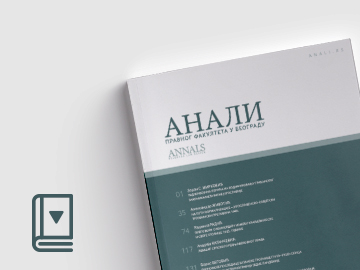
 © 1953 - 2026 · Annals of the