





Editorial board /
 Dr. Marija Karanikić Mirić [ Editor in Chief ]
Members / Dr. Dušan Popović, Dr. Mirjana Drenovak Ivanović, Dr. Danilo Vuković, Dr. Svetislav Kostić, Dr. Vojislav Stanimirović, Dr. Maja Lukić Radović
Web Editor / Dr. Boris Begović
Managing Editors / Dr. Nikola Ilić, Dr. Novak Vujičić
Technical Editors / Ksenija Džipković, Dr. Vukašin Stanojlović
- Author /
- Редакција 2025. године
- ADDENDUM /
Садржај
Author /- Редакција 2025. године
- ARTICLE /
Quine’s Two Dogmas of Empiricism and the Continuing Viability of Conceptual Jurisprudence The project of conceptual jurisprudence has been challenged on the ground it lacks normative implications that can help us to improve our legal practices. But the most serious challenge to the project has nothing to do with its practical value; it is has to do with its viability. Willard Van Orman Quine argues, in Two Dogmas of Empricism, that conceptual analysis is impossible because its objective is to explicate so-called analytic claims that, he argues, do not exist. This essay offers a new criticism of Quine’s arguments, namely that they misconceive the objective of conceptual analysis and that, in consequence, these arguments fail to refute its viability. The project of conceptual jurispudence remains alive and well.
- ARTICLE /
Interim Measures in Arbitration: The Serbian Perspective У овом раду реч је о привременим мерама које може одредити арбитражни суд у Србији и о могућности њиховог извршења. У уводном поглављу сагледава се правни оквир за привремене мере у српском праву и арбитражним правилима. У осталим поглављима тумачи се законо давство које домаћи судови и арбитри треба да примене када се суо че са правним празнинама везаним за привремене мере у арбитражи. Помоћу упоредноправних узора одређена је пожељна пракса у примени одредаба домаћег законодавства ради усвајања оптималних судских и арбитражних одлука и бољих легислативних решења у будућности. У другом поглављу размотрен је један хипотетички пример одређивања привремене мере. У трећем поглављу реч је о начину одлучивања арби тара о привременим мерама, врстама привремених мера и условима за њихово одређивање, те судском извршењу привремених мера домаћих арбитражних судова. На крају изведен је закључак о ограниченом про стору за тумачење, што говори у прилог прилагођавању законодавства савременим токовима.
- ARTICLE /
Settlement Facilitation by Arbitral Tribunals: Boosting Efficiency or Endangering Due Process Rights? The paper explores the concept of settlement facilitation by arbitral tribunals. After a brief overview of the relevant legislation regarding this practice, the paper focuses on different facilitating settlement measures that are available to arbitral tribunals. Finally, the author evaluates the advantages and disadvantages of arbitral tribunals encouraging the parties to find an amicable resolution of their dispute after the arbitration proceedings commence. While it is evident that an early settlement can significantly increase the dispute resolution process efficiency, are there also risks associated with the practice of settlement facilitation?
Author /- ARTICLE /
A New Chapter in Accountability: Transparency and Anonymisation in the Croatian Courts The ongoing digitalisation of judicial systems has intensified the debate over balancing the requirement of transparency and the right to privacy. In Croatia, recent legislative amendments mandate online publication of judgments, which marks a significant step toward ensuring transparency. However, this raises questions about reconciling public access to information with individual privacy protection. This article thus evaluates the implications of these changes, examining their compliance with privacy standards and their impact on judicial practices. It assesses whether current legal provisions adequately balance transparency and privacy, particularly by evaluating the existing anonymisation measures. By situating Croatia’s reforms within a comparative legal context, the study also highlights the challenges and opportunities in implementing the obligation of online publication of judgments. The findings aim to assess whether the current solution represents a balanced approach to achieving transparency in the judiciary while safeguarding privacy rights, and offer recommendations for potential improvements.
Authors /- ARTICLE /
The Internet as a Public Place: Framing the Debate in Bosnia and Herzegovina The Internet and digital platforms are often portrayed as public spaces, hosting both private conversations and discussions of public interest. Political campaigns are conducted and business transactions are also carried out there. This paper challenges this view by highlighting the differences between the Internet and traditional public places. Instead, it argues that the Internet increasingly resembles a mosaic of private domains controlled by a few powerful entities that dictate the flow of information. This paper examines the issue from the perspective of the benefits that public places provide in modern democratic societies and posits the debate within Habermas’s understanding of the public sphere, providing for differences in how public place is typically perceived regarding the Internet and especially digital platforms. Finally, it outlines the ongoing legislative debate in Bosnia and Herzegovina on this issue, with comparative insights from the legal frameworks of Serbia and Croatia.
Authors /- ARTICLE /
Navigating the Legal Waters: The Role and Liability of a Ship’s Captain in Roman Maritime Law The ship’s captain (magister navis) held a pivotal role in overseeing maritime operations and managing the vessel. Rooted in traditional legal concepts, Roman maritime law predominantly relied on the contract of locatio conductio. Since, under this contract, captains were liable for the delivery of goods rather than their safekeeping, this often led to fraudulent activities. To address these issues, the receptum nautarum was introduced to impose liability for the safekeeping of goods, allowing merchants to sue captains if goods were damaged or stolen during transit. Given this intricate commercial venture, the author aims to elucidate the captain’s legal relations with the beneficiary of the maritime venture (exercitor navis) on one hand, and with third parties on the other, as well as to prove that the captain was not initially liable for custodia.
- Author /
PUBLISHED IN THE SAME YEAR /
 The project of conceptual jurisprudence has been challenged on the ground it lacks normative implications that can help us to improve our legal practices. But the most serious challenge to the project has nothing to do with its practical value; it is has to do with its viability. Willard Van Orman Quine argues, in Two Dogmas of Empricism, that conceptual analysis is impossible because its objective is to explicate so-called analytic claims that, he argues, do not exist. This essay offers a new criticism of Quine’s arguments, namely that they misconceive the objective of conceptual analysis and that, in consequence, these arguments fail to refute its viability. The project of conceptual jurispudence remains alive and well.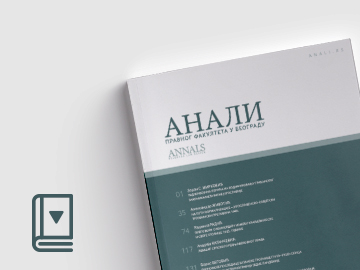
 © 1953 - 2026 · Annals of the