





Editorial Board /
 Dr. Marija Karanikić Mirić [Editor-in-Chief]
Members / Dr. Dušan V. Popović, Dr. Mirjana Drenovak Ivanović, Dr. Danilo Vuković, Dr. Svetislav V. Kostić, Dr. Vojislav Stanimirović and Dr. Maja Lukić Radović
Website Editor / Dr. Boris Begović
Secretaries / Dr. Nikola Ilić and Dr. Novak Vujičić
Technical Secretaries / Dr. Vukašin Stanojlović and Ksenija Džipković Marković
- CONTRIBUTION /
Complete issue ready for easy download
Author /- 2026 Editorial Board
- CONTRIBUTION /
Sadržaj
Author /- Redakcija 2026.
- ARTICLE /
Autonomous vehicle and the limits of traditional liability: between legal doctrine and technological innovation The paper examines legal liability for damages caused by autonomous vehicles by analyzing the legal and technical characteristics of highly automated and fully autonomous driving systems, as well as the relevant international, regional, and national legal frameworks. While existing motor vehicle insurance and product liability regimes provide an important foundation, they remain fragmented and insufficiently adapted to the technological and normative complexities of autonomous mobility. The paper demonstrates that traditional driver-based liability models are structurally misaligned with highly automated driving, creating systemic gaps in the allocation of liability. Adopting a doctrinal and comparative approach, it highlights the need for a coherent, flexible, and forward-looking regulatory framework capable of reconciling technological innovation with legal accountability. The findings contribute to the ongoing scholarly and policy debates on the future design of liability regimes for autonomous vehicles.
Authors /- ARTICLE /
The Harmonized Dissonance of Trade Usages: Turkish Law vs. Lex Mercatoria The Turkish Commercial Code distinguishes between commercial customary law and trade usage. Trade usage may be defined as actual practices or habits used in the interpretation of declarations of will in commercial relations, but which have not attained the status of customary law, unless the legislator has expressly provided for their application. In judicial decisions, however, trade usage is often treated as an abstract principle of law rather than as a concrete habit or practice to be applied in a particular dispute. After examining whether trade usages may serve as a basis for judicial decisions under Turkish law, this paper highlights the erroneous approach to trade usage in Turkish case law. It then compares Turkish law with relevant international instruments and examines whether the case law of the Turkish Court of Cassation is compatible with international commercial regulations.
- ARTICLE /
Personal Data Processing by the Police in Serbia: Assessing compliance with constitutional, ECHR and EU law standards The protection of natural persons regarding the processing of their personal data is a fundamental human right recognised in international and national law. Data protection principles and rules should be respected even when personal data is processed by law enforcement agencies. For the interpretation of this constitutionally guaranteed right, the standards from the case law of the European Court of Human Rights on data protection under Article 8 of the European Convention on Human Rights are relevant. In addition, the harmonisation of national legislation with EU rules on personal data processing for law enforcement purposes also serves to protect this right. The author analyses the domestic legal framework for data processing by the police, in order to establish whether and to what extent the national legal system has achieved compliance with the constitutional guarantee of the right to data protection, ECtHR standards and EU acquis.
Author /- ARTICLE /
Body Donation for Educational Purposes as a Testamentary Disposition The education of future medical practitioners and scientists requires adherence to ethical principles, the acquisition of theoretical knowledge, and the continuous development of practical skills. Even today, some of these skills can hardly be acquired without training on human cadavers. While cadaver dissection remains essential to medical education, it also raises important ethical and legal concerns. This article examines how medical schools in Serbia obtain bodies for educational purposes. Voluntary body donation by last will, once the most common practice, remains the only legal mechanism. This creates a significant gap between the need for teaching material and the strict formal requirements prescribed by law. Against the background of previous theoretical and empirical research, the article explores the rationale for these requirements, particularly in light of their inconsistency with related rules of Serbian inheritance law.
Authors /- ARTICLE /
Principles of Reinsurance Contract Law: Between Tradition and Legal Certainty in a Changing Global Order Reinsurance contracts have evolved significantly, transitioning from trust-based ‘gentlemen’s agreements’ to complex legal instruments featuring heightened risk exposure. This transformation is a consequence of the global expansion of the reinsurance market, the influx of new participants, and the increasing significance of reinsurance for financial stability. Reinsurance, however, continues to be unregulated at the national level and is predominantly governed by negotiated terms and established customs. This ‘pick-and-mix’ contractual approach now generates considerable legal uncertainty, particularly in cross-border transactions. To address these challenges, this paper examines the development of the Principles of Reinsurance Contract Law (PRICL), a non-binding soft law framework intended to enhance legal certainty. The PRICL drafters focused on prevailing customs systematization and offering clear contractual guidelines, while maintaining party autonomy through this opt-in mechanism. The paper concludes by analysing the legal avenues for PRICL contract incorporation, bearing in mind the constraints imposed by international private law.
Authors /- BOOK REVIEW /
Katharina Boele-Woelki and Maarit Jänterä-Jareborg (eds.), “What Family Law for Europe?”, Intersentia, 2025, 261
Author /-
PUBLISHED IN THE SAME YEAR /
-
 The paper examines legal liability for damages caused by autonomous vehicles by analyzing the legal and technical characteristics of highly automated and fully autonomous driving systems, as well as the relevant international, regional, and national legal frameworks. While existing motor vehicle insurance and product liability regimes provide an important foundation, they remain fragmented and insufficiently adapted to the technological and normative complexities of autonomous mobility. The paper demonstrates that traditional driver-based liability models are structurally misaligned with highly automated driving, creating systemic gaps in the allocation of liability. Adopting a doctrinal and comparative approach, it highlights the need for a coherent, flexible, and forward-looking regulatory framework capable of reconciling technological innovation with legal accountability. The findings contribute to the ongoing scholarly and policy debates on the future design of liability regimes for autonomous vehicles.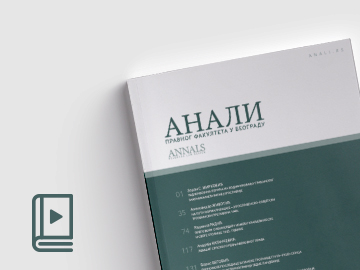
 © 1953 - 2026 · Annals of the